

A medical device can function as intended and still create unacceptable biological risks when it contacts the body. That is why ISO 10993 biocompatibility testing is an important part of medical device development, risk management, and regulatory planning.
ISO 10993 is not a universal checklist assigning the same tests to every product. It is a series of standards used to evaluate biological safety based on the finished device, intended use, materials, manufacturing, sterilization, contact location, and exposure duration.
Key Takeaways
- ISO 10993 is a biological safety framework, not one laboratory test.
- Contact type, location, frequency, and duration help determine which endpoints must be addressed.
- Addressing an endpoint does not always require a new test.
- Early coordination among development, regulatory, toxicology, and preclinical teams can prevent unnecessary studies and delays.
What Does ISO 10993 Cover?
ISO 10993 biocompatibility testing evaluates potential biological risks associated with a medical device that directly or indirectly contacts the human body. Testing may supply part of the evidence, but it belongs within a broader biological evaluation and risk-management process.
The current ISO 10993-1 standard is ISO 10993-1:2025, the sixth edition. It defines biological safety principles within the ISO 14971 risk-management process and emphasizes hazards, material characterization, and exposure.
The FDA also provides guidance on the use of ISO 10993-1 for pathways including 510(k), De Novo, IDE, and PMA. FDA entered partial recognition of ISO 10993-1:2025 into its consensus standards database on May 25, 2026.
Why ISO 10993 Is Not a Universal Testing Checklist
The endpoint tables provide a framework for deciding which biological effects require evaluation. They are not a fixed menu of tests.
Evaluation required does not always mean new testing required.
An endpoint may be addressed using:
- Existing device or material data
- Supplier documentation and scientific literature
- Chemical characterization or toxicological assessment
- Previous experience with an equivalent device
- Endpoint-specific testing
- A documented scientific rationale
FDA states that recommended endpoints should be addressed through existing data, additional testing, or a rationale explaining why further assessment is unnecessary. This risk-based approach focuses resources on genuine data gaps.
How Are Medical Devices Categorized?
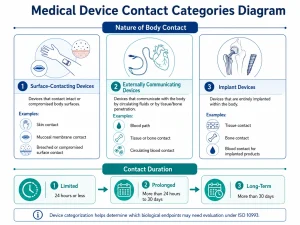
Biological evaluation starts by defining how the device interacts with the body.
Nature and Location of Contact
Devices are commonly categorized as:
- Surface-contacting devices, including products contacting skin, mucosal membranes, or compromised surfaces
- Externally communicating devices, including products contacting tissue, bone, dentin, blood paths, or circulating blood
- Implant devices, including products placed in tissue, bone, or blood-contacting locations
Contact Duration
FDA uses three general categories:
- Limited: 24 hours or less
- Prolonged: More than 24 hours through 30 days
- Long-term or permanent: More than 30 days
Repeated exposure may influence categorization, and device-specific guidance should be reviewed when classification is unclear.
Which Biological Endpoints May Need Evaluation?
Potential endpoints vary by device and may include:
- Cytotoxicity, sensitization, and irritation
- Acute, subacute, subchronic, or chronic systemic toxicity
- Material-mediated pyrogenicity
- Genotoxicity or carcinogenicity
- Reproductive and developmental toxicity
- Hemocompatibility
- Implantation and local tissue effects
- Degradation-related risks
- Chemical characterization and toxicological assessment
Cytotoxicity, sensitization, and irritation are frequently considered, but they are not a universal three-test requirement. Selection depends on the device’s materials, residues, sterilization, degradation, clinical use, and exposure.
The ISO 10993 Biological Evaluation Process
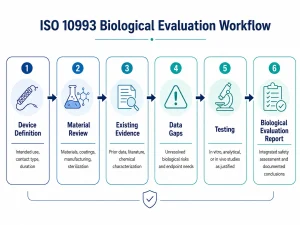
A practical ISO 10993 biocompatibility testing program usually follows these steps:
- Define the device and intended use. Document the patient population, anatomical contact, deployment method, frequency, and duration.
- Review materials and manufacturing. Evaluate materials, coatings, processing aids, cleaning agents, packaging, and sterilization.
- Gather available evidence. Review supplier data, literature, previous studies, chemical information, and comparable devices.
- Identify hazards and data gaps. Determine which risks are addressed and where additional evidence is needed.
- Prepare a Biological Evaluation Plan. Document relevant endpoints, evidence sources, proposed studies, and rationales.
- Conduct justified testing. Select appropriate analytical, in vitro, or in vivo methods for unresolved risks.
- Interpret the evidence. Consider results collectively within the medical device risk assessment.
- Prepare a Biological Evaluation Report. Summarize the evidence, conclusions, residual risks, and biological safety justification.
FDA evaluates the whole device in its final finished form, including sterilization when applicable, rather than reviewing raw materials alone.
When Are In Vivo Implantation Studies Needed?
An implantation study may be appropriate when existing information or alternative methods cannot adequately characterize local tissue response to an implanted or tissue-contacting product.
Planning may consider implant location, device configuration, duration, tissue response, degradation, histopathology, model selection, and GLP status. Animal studies are not automatically required for every endpoint.
IBEX supports medical device testing and in vivo implantation studies across orthopedic, surgical, and interventional applications. Its capabilities include custom protocols, relevant surgical models, long-term safety evaluations, and advanced imaging in a GLP-compliant, AAALAC-accredited research environment.
Common ISO 10993 Planning Mistakes
MedTech teams can reduce rework by avoiding these problems:
- Treating endpoint tables as mandatory test checklists
- Starting studies before confirming device categorization
- Testing raw materials instead of a representative finished device
- Overlooking sterilization, cleaning agents, or manufacturing residues
- Using a test article that does not represent the marketed configuration
- Failing to assess material, supplier, process, packaging, or intended-use changes
- Omitting scientific rationales for endpoints that do not need further testing
- Assuming one successful study guarantees FDA acceptance
What Information Should You Give a Preclinical Research Partner?
Prepare the following before requesting a study proposal:
- Device description, intended use, and development stage
- Target market and expected regulatory pathway
- Patient-contacting materials
- Contact type, location, frequency, and duration
- Manufacturing, cleaning, and sterilization details
- Existing biological, chemical, or toxicological evidence
- Material, supplier, or process changes
- Deployment method and clinical environment
- Desired endpoints and study objectives
- GLP status, reporting needs, and target dates
Clear information helps the research partner recommend an appropriate model, protocol, test article, and data package.
How IBEX Supports Medical Device Biocompatibility Programs
IBEX Preclinical Research has more than 20 years of experience supporting medical device and orthopedic research. Its preclinical research services include GLP and non-GLP studies, implantation, long-term evaluations, veterinary oversight, and access to partner-supported analytical chemistry, histopathology, SEND reporting, and GLP quality assurance auditing.
For products requiring specialized models, IBEX develops custom preclinical studies around the device’s intended use and research objectives. Its surgical facilities and imaging technologies can support clinically relevant procedures and longitudinal evaluation.
Build Biological Safety Into Development Early
Effective ISO 10993 biocompatibility testing starts with a clear understanding of the finished device, clinical use, biological hazards, available evidence, and unresolved data gaps.
A device-specific plan can reduce unnecessary testing and strengthen regulatory evidence. An experienced preclinical partner can align the model and protocol with the intended use.
Contact IBEX Preclinical Research to discuss your device, study objectives, regulatory considerations, and preclinical testing needs.
Frequently Asked Questions About Medical Device Biocompatibility
Does Every Medical Device Require ISO 10993 Testing?
Devices with direct or indirect body contact generally require biological safety consideration. The amount of new testing depends on the device, available evidence, contact characteristics, applicable guidance, and identified data gaps.
What Tests Are Required by ISO 10993?
There is no universal testing package. Relevant endpoints depend on materials, manufacturing, intended use, body contact, degradation, patient population, and existing evidence.
What Is the Difference Between a Biological Evaluation Plan and a Biological Evaluation Report?
The plan defines the prospective strategy, endpoints, evidence, and proposed testing. The report evaluates the complete data and documents the biological safety conclusions and residual risks.
Can Previous Biocompatibility Data Support a Modified Device?
Previous evidence may be useful when equivalence is scientifically justified. Changes to materials, suppliers, processing, cleaning, sterilization, packaging, geometry, or intended use should be reassessed.
Should Testing Use the Final Finished Device?
Testing should generally represent the final finished device, including applicable manufacturing and sterilization effects. A nonrepresentative test article may limit the relevance of the results.