


Some studies explore feasibility, improve a prototype, or confirm surgical workflow. Others generate formal data for regulatory review. Understanding GLP vs non-GLP preclinical studies helps teams choose the right path.
The right approach depends on device stage, study goals, risk, timeline, budget, and regulatory intent. An early concept may not need the same study structure as a device preparing for an IDE, PMA, De Novo, or 510(k) submission.
IBEX Preclinical Research supports MedTech teams with protocol development, study design, in-vivo testing, medical device testing, orthopedic and soft tissue models, imaging support, data collection, and reporting.
What Are GLP Preclinical Studies?
GLP preclinical studies are conducted under Good Laboratory Practice requirements. In the United States, these requirements are outlined in 21 CFR Part 58 Good Laboratory Practice. GLP standards support data quality, traceability, documentation, and study integrity.
For medical device companies, GLP medical device testing may be expected when a study is intended to support a regulatory submission or formal safety evaluation. These studies usually include approved protocols, quality assurance oversight, controlled data collection, complete records, and structured final reports.
GLP-compliant preclinical research may be appropriate for FDA submissions, IDE applications, PMA or De Novo pathways, certain 510(k) submissions, implantation studies, safety evaluations, or performance assessments where regulatory-grade data is expected.
However, not every medical device automatically requires GLP testing. Requirements depend on the device type, risk level, intended use, study purpose, and regulatory pathway.
What Are Non-GLP Preclinical Studies?

Non-GLP preclinical studies are not conducted under full GLP compliance, but they can still be carefully designed and scientifically useful. They are often used earlier in development to answer practical questions before investing in a regulatory-facing study.
Non-GLP medical device testing may help teams evaluate early feasibility, proof of concept, prototype performance, surgical handling, anatomical fit, imaging visibility, model selection, or procedural workflow.
Many teams use non-GLP studies first to refine the device and procedure before moving into GLP-compliant testing. For example, an orthopedic device company may run a non-GLP pilot study to evaluate implant placement, fixation technique, instrumentation, or imaging needs. Once the design and workflow are more mature, the team may plan a GLP study for regulatory use.
GLP vs Non-GLP Preclinical Studies: Key Differences
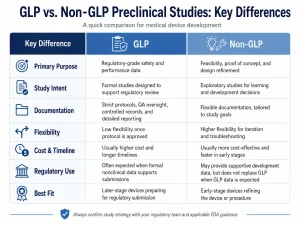
The main difference between GLP and non-GLP testing is the intended use of the data. Non-GLP studies are usually exploratory. They help teams learn, adjust, and make development decisions. GLP studies are more formal and often support safety or performance data for regulatory review.
Key differences include:
Study intent: Non-GLP studies are typically used for feasibility, prototype refinement, and proof-of-concept work. GLP studies are usually used when data may support regulatory submissions.
Documentation: Non-GLP studies can include strong records, but GLP studies require more formal documentation, protocol controls, raw data management, QA oversight, and reporting.
Flexibility: Non-GLP studies may allow more room to troubleshoot or adjust procedures. GLP studies are more controlled and must follow the approved protocol.
Cost and timeline: Non-GLP studies are often faster and more cost-effective for early learning. GLP studies usually require more planning, documentation, quality review, and reporting.
Regulatory value: Non-GLP data may support internal decisions or development history. GLP data may be expected when safety data is used for an FDA-facing submission.
When Are GLP Preclinical Studies Required?
GLP studies may be required or expected when the data will support a regulatory submission and the study evaluates safety in a nonclinical model. This may apply to certain studies supporting an FDA Investigational Device Exemption, PMA, De Novo submission, or other regulatory pathway.
That does not mean every device needs GLP testing. FDA preclinical testing requirements vary based on device classification, intended use, risk level, predicate support, available bench data, and clinical strategy.
Device teams should avoid assuming GLP is always required or assuming non-GLP studies can replace GLP studies when GLP data is expected. Confirm your regulatory strategy with a regulatory consultant, FDA pathway guidance, applicable standards, and, when appropriate, FDA feedback.
When Are Non-GLP Studies Useful?
Non-GLP studies are useful when the device, procedure, or protocol is still evolving. They allow teams to learn before locking into a formal study design.
A non-GLP study may be appropriate when you need to compare prototypes, refine geometry or materials, evaluate surgical access, test device handling, confirm animal model fit, identify imaging needs, or determine whether planned endpoints are realistic.
This is especially valuable for medical device feasibility testing and proof-of-concept preclinical studies. A phased approach can reduce the risk of running a GLP study too early with an immature device, unclear endpoints, or an unproven procedure.
For many companies, non-GLP work is not a shortcut. It is a risk-reduction step before investing in GLP-compliant preclinical research.
Can Non-GLP Data Be Used for FDA Submissions?
Sometimes non-GLP data may be included as supportive information, especially when it explains feasibility work, development history, prototype iteration, or early observations. However, non-GLP data should not replace GLP data when GLP-compliant results are expected.
The key question is how the data will be used. If the study supports internal design decisions, non-GLP may be appropriate. If the study supports safety claims in a regulatory submission, GLP may be expected.
Before starting medical device preclinical testing, teams should ask:
- What decision will this study support?
- Will the data be used internally or submitted externally?
- Is the study exploratory or regulatory-facing?
- What claims will be made from the results?
- What documentation will be needed later?
How to Choose the Right Preclinical Study Design
Choosing between GLP vs non-GLP preclinical studies starts with the study objective.
If your device is still changing, a non-GLP feasibility or pilot study may be the better first step. If the device design is finalized and the data will support a regulatory submission, a GLP study may be more appropriate.
Teams should also consider device risk. Implantable devices, orthopedic devices, surgical devices, and soft tissue technologies may require more detailed model selection, endpoint planning, imaging, and reporting.
An experienced preclinical CRO for medical devices can help determine the right model, procedure, endpoints, sample size, documentation level, and reporting structure. IBEX supports teams with medical device testing, orthopedic preclinical research, in-vivo testing, custom procedures, imaging support, data collection, and reporting.
Why a Phased Strategy Can Reduce Risk
Many MedTech teams begin with non-GLP testing, then move into GLP testing when the device and study design are more mature.
A phased strategy may include:
- Feasibility study: Evaluate handling, placement, and early performance.
- Pilot or proof-of-concept study: Refine the model, endpoints, imaging, and technique.
- GLP-compliant study: Generate formal regulatory-facing data.
- Final reporting: Organize findings for regulatory planning.
This approach can help reduce unnecessary costs, avoid delays, and improve final study data quality.
Conclusion
Choosing between GLP vs non-GLP preclinical studies is not about selecting the most formal option every time. It is about matching the study to the device stage, testing objective, risk level, and regulatory intent.
Non-GLP studies are valuable for feasibility, proof-of-concept work, prototype refinement, and surgical planning. GLP studies are important when regulatory-grade safety or performance data is expected.
Need help selecting the right study path? Contact IBEX Preclinical Research to discuss protocol development, study design, in-vivo testing, custom procedures, imaging support, data collection, and reporting.
FAQs About GLP vs Non-GLP Preclinical Studies
What is the difference between GLP and non-GLP preclinical studies?
GLP studies follow formal Good Laboratory Practice requirements and are often used for regulatory-grade safety data. Non-GLP studies are usually used for feasibility, prototype refinement, and internal development decisions.
When are GLP preclinical studies required for medical devices?
GLP studies may be required or expected when data will support safety or performance information in an FDA submission. Requirements depend on device type, risk level, intended use, and regulatory pathway.
Are non-GLP studies useful for medical device development?
Yes. Non-GLP studies can help teams evaluate feasibility, surgical handling, model selection, imaging needs, prototype performance, and proof of concept before investing in GLP testing.
Can non-GLP data be used for FDA submissions?
Non-GLP data may sometimes be included as supportive information, but it should not replace GLP data when GLP-compliant results are expected.
Should a device company start with non-GLP testing before GLP testing?
Many teams do. Non-GLP testing can help refine the device, procedure, model, endpoints, and imaging plan before a more formal GLP study.
How do I choose the right preclinical study design for my device?
Start with the study goal, device stage, risk level, regulatory pathway, and intended use of the data. Then plan the model, endpoints, documentation, and reporting.